Understanding the Composite Chart: How Astrology Shows a Relationship’s Own Personality
By Camilla · September 9, 2026
What a Composite Chart Actually Is
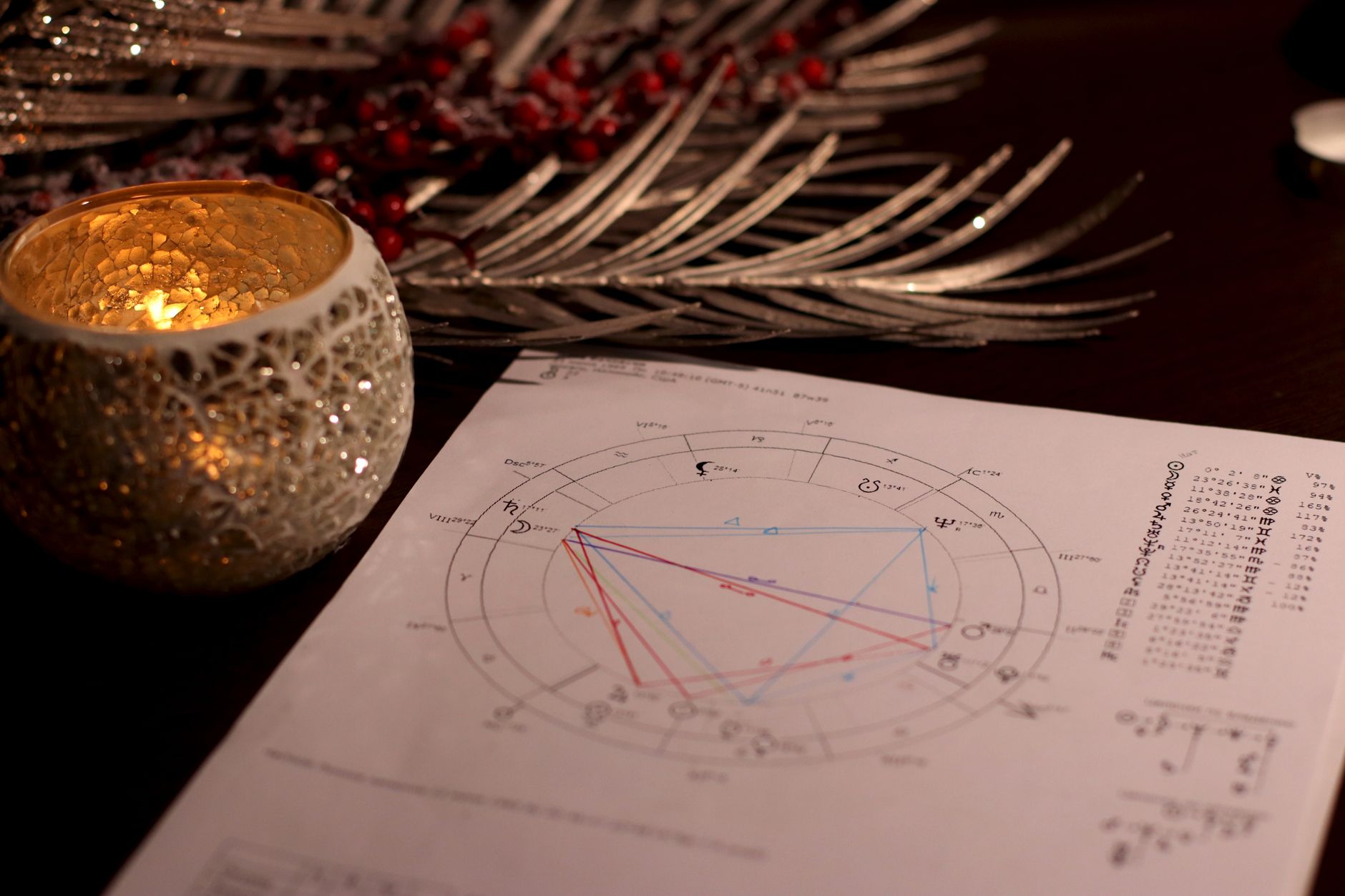
A composite chart is a single horoscope that astrologers create to represent the relationship between two people as if it were its own living entity. Instead of showing where the planets were for one person at birth, the composite chart takes the middle point — the exact halfway spot — between each partner’s planetary positions and plots those midpoints together. The result is a chart that astrologers read to see the shared strengths, challenges, and overall tone of the partnership, much like reading a natal chart reveals an individual’s personality.
How Astrologers Build It Step by Step
To make a composite chart, you start with the birth data — date, time, and place — for each person. From that data you calculate where each planet (the Sun, Moon, Mercury, Venus, Mars, Jupiter, Saturn, Uranus, Neptune, Pluto) was in the sky at the moment of birth. For every planet, you find the degree and sign it occupied for person A and the same for person B. Then you add those two degrees together and divide by two; that average is the midpoint. You do this for every planet, and you also calculate the midpoint of the two Ascendants — the sign that was rising on the eastern horizon at each birth — to get the composite Ascendant. Finally, you place all those midpoint planets and the composite Ascendant into a new chart wheel, using the same house system you would use for a natal chart. Some astrologers note that modern software, like the calculations used in Aether, derives these midpoints directly from the planets’ actual orbital positions rather than from simplified tables, which keeps the math accurate to the real sky.
Why People Look at a Composite Chart
People turn to the composite chart when they want insight into how a relationship functions as a whole, beyond the individual personalities of the two partners. Because the chart blends the two sets of planetary energies, it highlights themes that emerge when those energies interact — such as whether the partnership tends toward stability (shown by strong Saturn or Capricorn influences) or excitement (shown by active Uranus or Aries placements). The composite chart can also reveal shared life purposes, indicated by the composite Sun’s house and sign, and point out areas where the couple may need to work together, shown by challenging aspects like squares or oppositions between composite planets. Unlike synastry, which compares one person’s planets to the other’s to see where they click or clash, the composite chart treats the relationship itself as a third entity, offering a view of the “we” rather than just the “you” and “me”.
A Simple Example to See It in Action
Imagine Alex, born with the Sun at 10° Aries, and Sam, born with the Sun at 20° Leo. To find the composite Sun, you add 10° and 20° to get 30°, then divide by two, yielding 15°. Since 30° equals 0° Taurus (because each sign spans 30°), the composite Sun lands at 0° Taurus. This suggests the relationship’s core identity feels grounded, steady, and oriented toward building lasting value — qualities of Taurus — even though each partner individually expresses fiery, enthusiastic energy (Aries and Leo). If Alex’s Moon is at 5° Cancer and Sam’s Moon is at 25° Scorpio, the midpoint is (5° + 25°) / 2 = 15°, which falls in Leo (because 5° Cancer is 95° along the zodiac, 25° Scorpio is 235°, sum 330°, half 165°, which is 15° Leo). The composite Moon in Leo points to a shared emotional need for recognition, warmth, and creative expression within the partnership. By looking at the composite Ascendant, Mercury, Venus, and so on, an astrologer can piece together a narrative about how the pair communicates, shows affection, handles conflict, and pursues joint goals — all read from one chart that belongs to the relationship itself.
Frequently Asked Questions
Do I need to know the exact birth time to make a composite chart?
Yes, because the Ascendant and house placements depend on the exact moment and location of birth; without an accurate time, the composite Ascendant and house cusps will be approximate.
Is a composite chart the same as a relationship synastry chart?
No, synastry places each person’s planets side‑by‑side to see how they interact, while a composite chart blends the two sets of planets into one new chart that represents the partnership as its own entity.
Can a composite chart predict whether a relationship will last?
Astrologers use the composite chart to describe the relationship’s inherent tone and challenges, not to guarantee outcomes; lastingness depends on many factors, including free will and circumstances outside the chart.