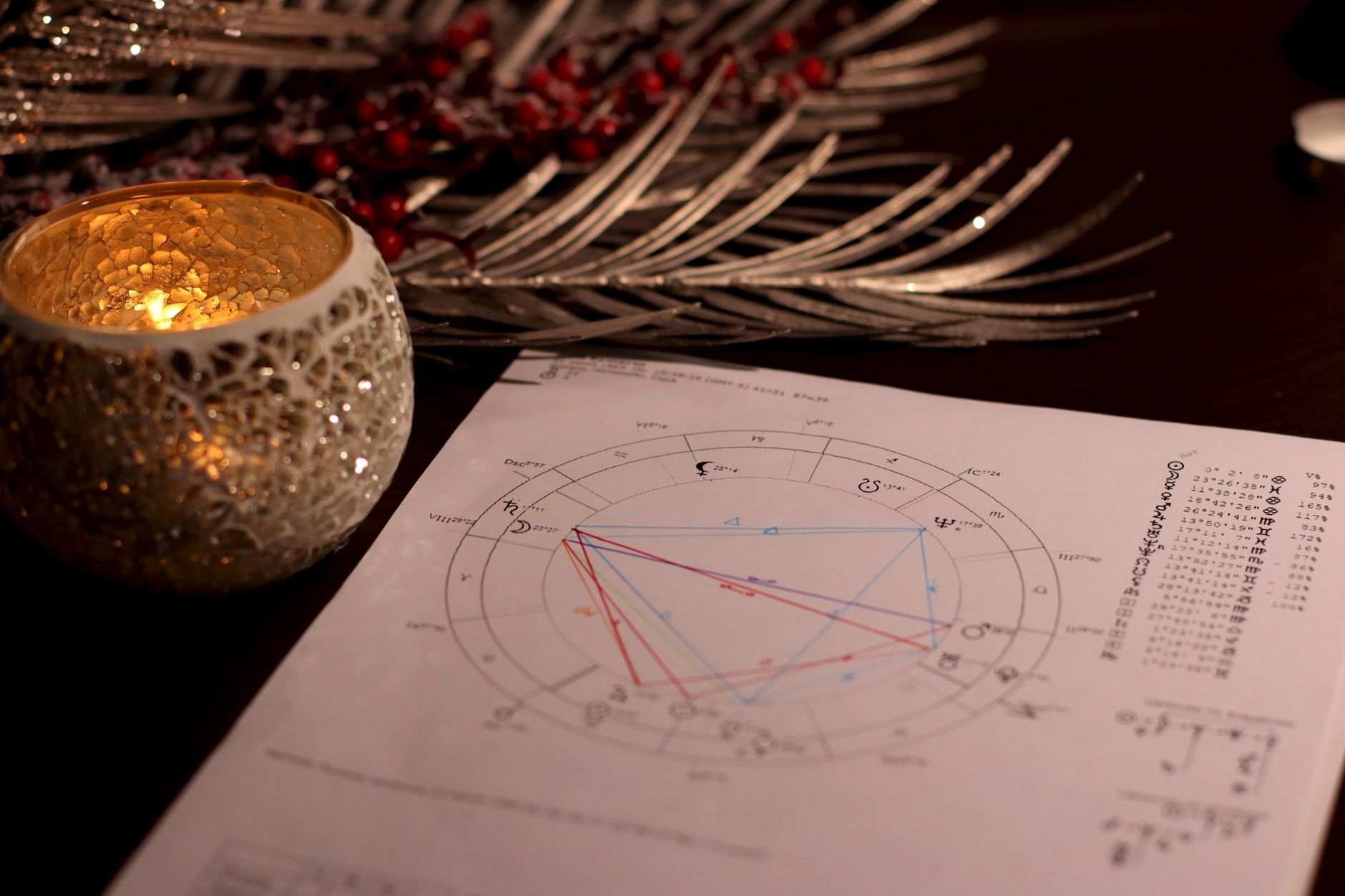
Understanding Your Solar Return Chart: A Yearly Snapshot of the Sky
By Camilla · September 21, 2026
A Solar Return chart is a diagram that astrologers create for the exact moment each year when the Sun returns to the same place in the sky it occupied when you were born. The diagram shows where the Sun, Moon, and planets were at that precise time, using the same kind of sky map that is used for a birth chart, but it is calculated for your birthday each year instead of the moment you were born.
What the Chart Actually Shows
When astrologers talk about a “chart,” they mean a round picture that places the Earth at the center and shows where each celestial body appeared in the sky from that point of view at a specific time. For a Solar Return, the time chosen is the instant when the Sun’s longitude matches the longitude it had at your birth. Because the Earth orbits the Sun once a year, this moment happens roughly on your birthday, though it can fall a day before or after due to the exact speed of Earth’s orbit.
The chart therefore captures a snapshot of the heavens for that one moment. It includes the Sun’s position (which will be exactly the same as in your birth chart), the Moon’s location, and the placements of Mercury, Venus, Mars, Jupiter, Saturn, Uranus, Neptune, and Pluto. Each planet’s location is noted by the zodiac sign it sits in and the degree within that sign. The chart also marks the horizon line (the Ascendant) and the meridian (the Midheaven), which are reference points that help astrologers see how the planets relate to your personal orientation in the world.
All of this is presented in a visual format that looks like a pie divided into twelve slices, each slice representing one of the twelve zodiac signs. The planets are placed inside the slices according to where they were in the sky at the chosen moment. This visual lets astrologers see patterns, such as whether several planets cluster in one sign (which astrologers call a stellium, meaning a group of planets close together) or whether two planets sit opposite each other (an opposition, meaning they are about 180 degrees apart).
How Astrologers Use the Chart in a Reading
Astrologers treat the Solar Return chart as a thematic overlay for the coming year. They compare it to your natal chart—the chart cast for your birth moment—to see where the yearly energies line up with your lifelong patterns. For example, if the Solar Return Sun falls in your natal tenth house (the area of the chart associated with career and public life), astrologers might interpret the year as one where work, reputation, or long‑term goals come into focus.
They also look at the Solar Return Moon to gauge emotional tone. If the Moon is in a water sign like Cancer, Scorpio, or Pisces, the year may feel more intuitive, sensitive, or inwardly focused. If it lands in an air sign such as Gemini, Libra, or Aquarius, the emphasis might be on communication, ideas, or social connections.
Aspects between Solar Return planets and natal planets are examined as well. A conjunction (when two planets share the same degree) can indicate a blending of energies, suggesting that the themes of the transiting planet will be especially strong in the area of life ruled by the natal planet. A square (a 90‑degree angle) often points to tension or challenges that require effort to resolve, while a trine (a 120‑degree angle) tends to signal flow and ease.
Because the Solar Return is recalculated each year, it offers a fresh perspective that reflects the shifting celestial backdrop while still being anchored to your personal birth map. Many people find it helpful to read their Solar Return before their birthday to set intentions, or after the year has passed to reflect on how the themes played out.
A Simple Example
Imagine someone born on March 15, 1990, with the Sun at 24 degrees of Pisces. Each year, around March 15, the Sun returns to that exact 24‑degree Pisces point. In 2024, the precise moment occurs on March 14 at 08:23 UTC. An astrologer would calculate a chart for that exact time and place (using the person’s birth location).
Suppose the resulting Solar Return chart shows the Moon at 10 degrees of Scorpio, Mercury at 2 degrees of Aries, and Venus conjunct the natal Mars at 18 degrees of Taurus. The interpreter might note:
- The Moon in Scorpio suggests a year where deep emotions, secrets, or transformative experiences could surface, especially in areas of intimacy or shared resources.
- Mercury in Aries points to quick, assertive thinking and possibly a tendency to speak or act before fully reflecting—useful for starting new projects but requiring mindfulness to avoid impulsiveness.
- Venus conjunct natal Mars indicates that the energies of love, desire, and drive are merging, which could bring passionate relationships or a strong push to pursue creative endeavors with vigor.
By reading these symbols in plain language—talking about feelings, thoughts, and drives rather than abstract glyphs—the astrologer gives the person a concrete sense of what themes might arise during the coming year, helping them plan, reflect, or simply stay aware of the energies at play.
---
Frequently Asked Questions
Do I need to know my exact birth time to get a Solar Return chart?
Yes, because the chart uses the Ascendant and house positions, which shift quickly with time; an accurate birth time gives a more meaningful reading, though the Sun’s position alone will still be correct even if the time is approximate.
Is a Solar Return chart the same as a horoscope I read in a newspaper?
No; newspaper horoscopes are generic Sun‑sign forecasts, while a Solar Return is a personalized chart calculated for your exact birth data and the moment the Sun returns to its natal position each year.
Can I calculate my own Solar Return chart, or do I need an astrologer?
You can use many free online tools that ask for your birth date, time, and place and then compute the chart for you; however, interpreting the symbols meaningfully often benefits from studying astrology basics or consulting a knowledgeable practitioner.